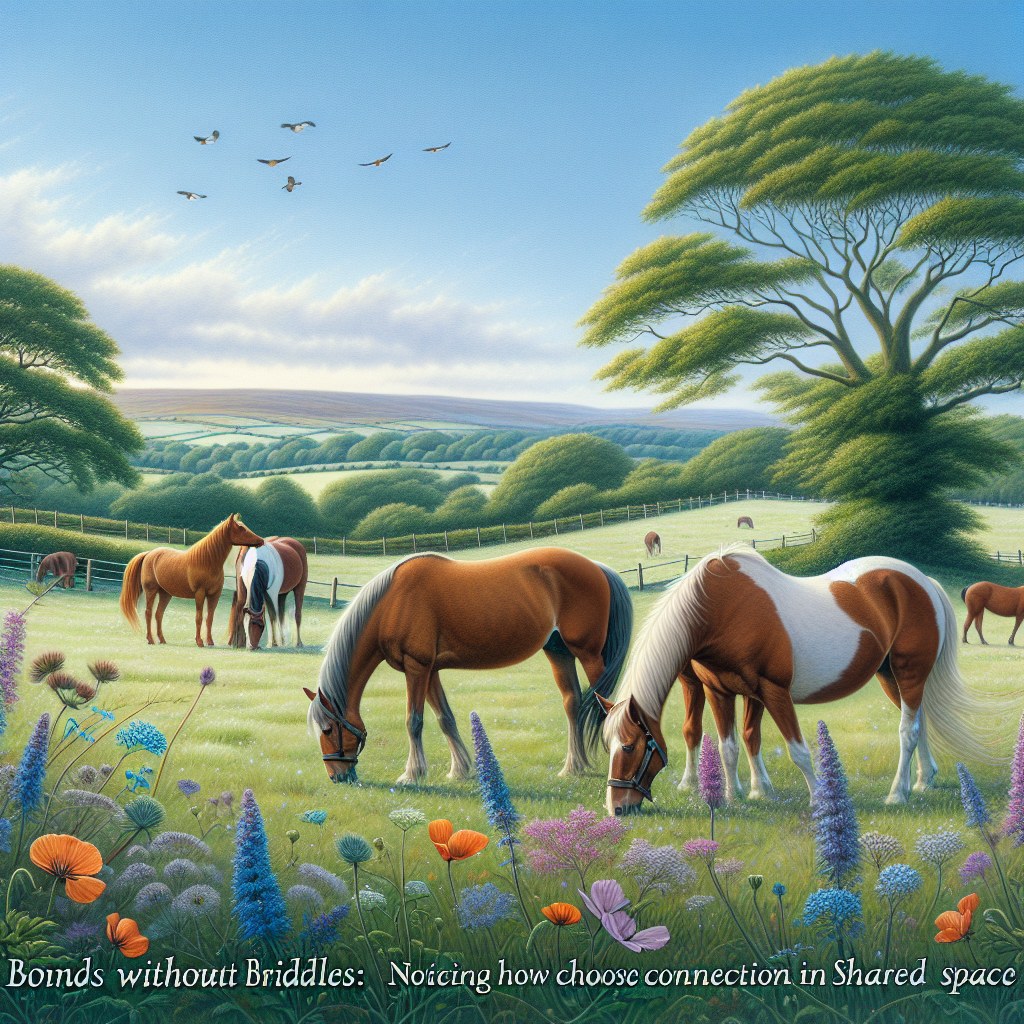
Borrowing the Herd’s Tempo: Rhythm as a Quiet Way to Coexist with Horses


Hook
Stand near a herd long enough and you’ll notice something that doesn’t need ropes, cues, or noise: horses flow together as if they’re listening to one shared beat. Step into that space with a racing mind and tense shoulders, and the "music" changes—often the horses drift away, watching. Arrive quietly, breathe, soften your look, and they may choose to come closer.
This isn’t about riding or training. It’s about coexistence—and the simplest tool is rhythm.
Basic concept
Horses are constantly reading our internal state. When we bring agitation, they often keep distance. When we bring calm, they’re more likely to approach and make contact.
From there, something subtle can happen: synchronization. When a person walks calmly alongside a horse, breathing and footsteps can start to align. The horse matches the human’s tempo, and the human subconsciously matches the horse’s. It becomes a non-verbal conversation—less about control, more about shared timing.
Rhythm is a social language, not a dominance story
It’s tempting to explain every interaction with a simple “alpha hierarchy.” But stable herds aren’t primarily maintained by constant fighting. The visible order often comes from relationships that reduce friction—bonds, tolerance, distance, and timing.
Dominance isn’t a fixed personality label; it’s situational and relationship-based (who yields to whom around specific resources). Leadership isn’t one permanent boss either; movement and decisions can be distributed depending on context.
Rhythm fits this reality: the herd doesn’t need nonstop confrontation to coordinate. Often, it’s small shifts—who pauses, who yields, who angles their body away—that keep the peace.
A coexistence practice: watch for the herd’s “beat”
Without trying to teach anything, you can learn a lot by observing the herd’s timing.
- Proximity patterns: Who repeatedly chooses to stand or rest near whom? Pairings that repeat are information.
- Affiliative behaviors: Look for mutual grooming, calm following, shared resting—these are the quiet bonds.
- Tolerance at resources: Notice yielding, allowing access, and calm passing—moments where timing prevents friction.
- Low-level signals: Ears, head turns, body angle, stepping aside. Often the herd resolves tension before it becomes dramatic.
Instead of asking, “Who’s in charge?” try asking, “Whose timing is being respected right now?”
Bringing your human rhythm into the shared space
Coexistence starts before you move a single step. Horses mirror what you bring.
- If you enter with a tense body and fast mind, don’t be surprised if the herd holds distance.
- If you pause, breathe, and let your posture soften, you may see a change: a quieter watch, an approach, a willingness to share space.
This is not a technique and not a demand. It’s an invitation to match the environment the horses already live in: one where harmony is often built through timing, spacing, and calm signals rather than force.
Closing thought
In the herd, peace isn’t usually announced—it’s arranged. And one of the most powerful ways to coexist with horses, without riding or training, is to stop trying to “lead the story” and start listening for the tempo already there.