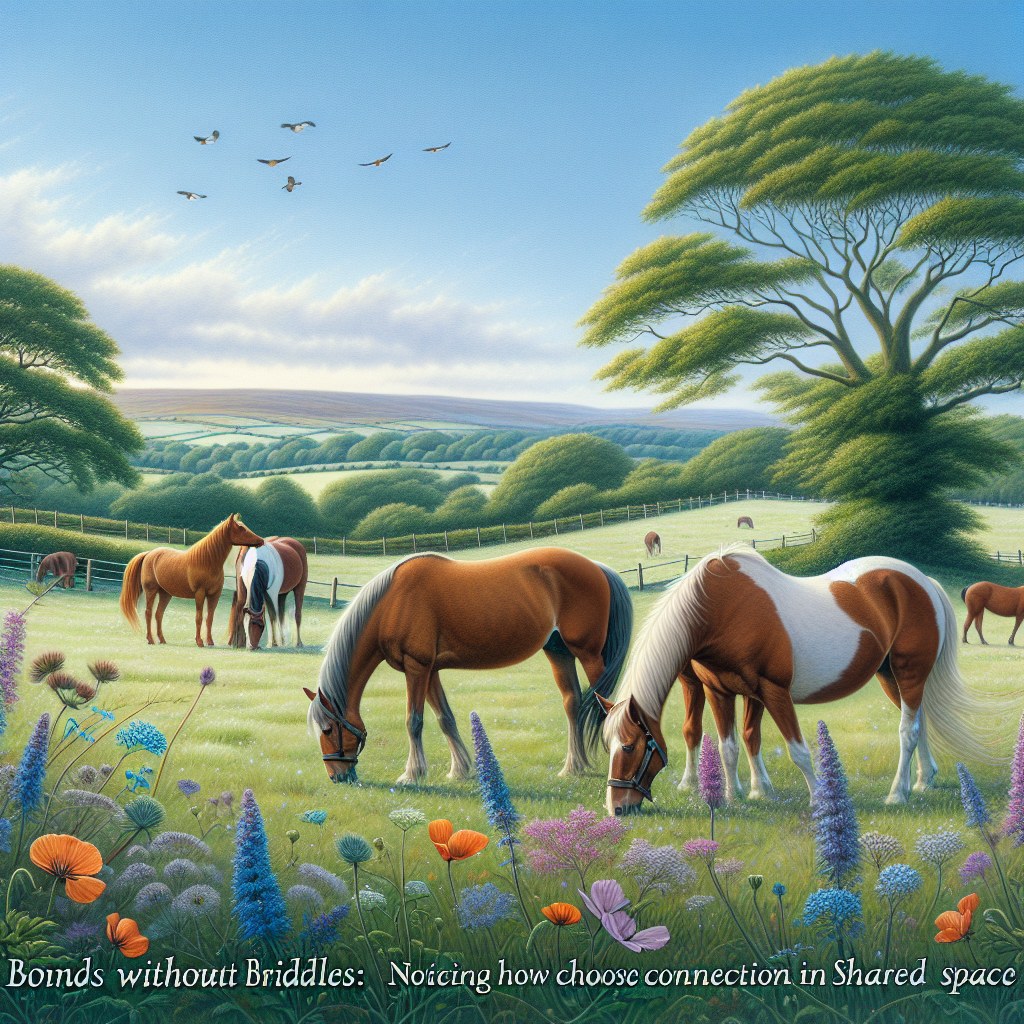
Bonds Without Bridles: Noticing How Horses Choose Connection in Shared Space
Hook
What does "living with" horses truly look like when you never request performance, never mount up, and never transform each encounter into a training session? The answer is remarkably straightforward: you observe how they select one another. Connections within a herd aren't merely poetic additions—they represent one of the most functional methods horses use to maintain predictability, security, and minimal conflict. When people withdraw from riding and training, these bonds become the most reliable guide for respectful shared living.
1) Bonds are visible: start with who chooses whom
A connection frequently reveals itself in the most unassuming manner: two horses consistently positioning themselves in the same peaceful area. Across several days, you might observe the same duo gravitating toward each other as the herd relaxes, or picking adjacent locations during rest periods. This "opting for proximity" holds significance because it's entirely voluntary. No lead rope, no signal, no force—simply preference.
For human cohabitation, this redefines your function. Rather than controlling horses through imposed organization, you can start by acknowledging the organization they've already established. When one horse regularly positions itself beside another, that's data about security, confidence, and emotional support. It also provides practical insight: splitting that pair "for convenience" might generate restlessness that appears to be a behavioral issue, when it's really a relationship being disrupted.
2) The small kindnesses: grooming, following, shared rest
Certain bonds are expressed through physical contact. Reciprocal grooming stands out as one of the simplest affiliative behaviors to identify: two horses alternating scratches on difficult-to-reach areas. It may appear unhurried, nearly drowsy. Yet its significance is dynamic—a commitment to the connection.
Other bonds are expressed through movement. Peaceful following serves as a subtle indicator: one horse trailing another without pressing, without pursuing, without stress. Communal resting represents another: a horse deciding to recline or nap because a favored companion is close by. These instances aren't "dominance demonstrations." They form the social foundation of living together.
When people refrain from riding or training, these observations become central to horse care. Your purpose transitions from "creating outcomes" to "recognizing what already exists." Remaining present without objectives isn't inactive; it's a method of honoring that horses possess their own social existence—and that this social existence shapes how secure and calm they feel in a common environment.
3) Status isn't a permanent badge: bonds change what you think you know
Observers frequently attempt to reduce horses to a straightforward narrative: one leader, everyone else follows. But watch extensively and that narrative becomes complicated. A horse who moves aside at feeding time may be the one others prefer to stand alongside later. A horse who displaces another from a resource might still look for comfort from a specific companion when the group reorganizes.
This holds importance for cohabitation because it discourages categorization. If you determine a horse is "the alpha," you might miss when that same horse defers peacefully in different circumstances—or when genuine stability emerges from who accepts whom, and who can move past without friction. Bonds can ease tensions. They can also reveal how situation-specific social positions truly are. In an active herd, relationships aren't permanent hierarchies imprinted on characters; they are continuous negotiations influenced by location, resources, and shared history between individuals.
4) Resource moments reveal relationship quality—especially patience
If you seek a practical field method to comprehend bonds without meddling, observe what occurs around communal resources. You needn't instigate conflict or arrange experiments. Just watch ordinary instances: who permits another to draw near, who holds back, who retreats with little drama.
Giving way can be collaborative rather than anxious. Permitting access near hay or water can resemble a silent understanding: one horse feeds, another advances, the first moves slightly, and existence proceeds. Tranquil navigation through tight spaces offers another illuminating scene. In a balanced group, numerous potential conflicts dissolve through tiny adaptations—minor shifts in stance and tempo that avert escalation.
For people, this serves as an invitation to cease viewing every action as a dominance contest. Moving aside can represent politeness. A head rotation can be a courteous inquiry. These are social abilities horses employ to maintain functional shared living. When we honor these abilities, we share space more elegantly—because we abandon attempts to "fix" communication that already works.
5) The language is low volume: ears, angles, and half-steps
Herd existence brims with cues that are simple to overlook if you only search for dramatic actions. Notice ears that pivot momentarily, a head that rotates just sufficiently to recognize another horse, a body that positions to establish space without physical contact. Frequently, the most significant moments occur before anything "major" transpires.
Moving aside can constitute an entire exchange. A horse might redistribute weight, adjust a shoulder, and the other horse alters direction. No striking, no nipping, no pursuit—merely information transmitted and acknowledged. These subtle signals demonstrate the protective aspect of bonds: horses familiar with each other typically address friction promptly, requiring less escalation.
Human cohabitation gains from embracing the same intensity. Rather than intervening hastily, dividing, correcting, or presuming threat at every flattened ear, you can develop the skill of observing progressions. Numerous herds regulate themselves. Your peaceful observation integrates into the surroundings: reliable, unthreatening, and less apt to interrupt the horses' inherent social resolution.
6) Coexisting through food: supporting natural choice without a timetable
A bond-centered perspective on cohabitation extends beyond social exchanges—it encompasses how horses occupy the majority of their day: grazing. One useful approach mentioned in the sources involves avoiding strict feeding timetables and encouraging more instinctive foraging patterns. The focus lies on offering access to various hay types and wild plants so horses can pick what they require.
Even without exploring specific arrangements or instructional guides, the concept remains evident: when horses can fulfill their drive to search, taste, and select, everyday existence becomes less centered on expectation and rivalry. This fosters more peaceful group dynamics because it corresponds with horses' natural tendencies: roaming, browsing, and making minor choices continuously throughout the day. Within that framework, bonds represent more than fellowship—they constitute part of how horses participate in a way of life constructed around continuous, autonomous activity.
7) What humans can offer: time, consistency, and respectful distance
Cohabitation without riding or training doesn't signify inactivity. It signifies providing the type of presence that doesn't perpetually disrupt horse connections. You can offer time—sufficient days of watching to witness recurring partnerships rather than isolated instances. You can offer consistency—appearing in a manner that doesn't require a response. And you can offer respectful distance—permitting horses to resolve conflicts through understated gestures when doing so is safe.
When you structure your horse care around bonds, the herd transforms into the instructor. You start to recognize that much of "structure" originates from preference, acquaintance, and modest acts of self-control. And through that understanding, cohabitation becomes less focused on dominance and more centered on common ground—where horses stay true to their nature, and people develop the awareness to perceive the connections that enable this possibility.
Equine Notion https://equinenotion.com/